Showing posts with label creative. Show all posts

Monday, January 4, 2016

Not your Common Veterinarian

Last month, I had the privilege of tracking down Elliott Garber, DVM, a unique veterinarian and author. He had some great stuff to tell me about his journey to getting his first novel published, establishing a platform, his writing process, and his secrets to staying focused as a writer. I'd like to share our conversation with you in this month's VetWrite.

Firstly, I had to clarify exactly what Elliott is doing professionally at the moment. You see, Elliott's fascinating blog, The Uncommon Veterinarian, is thick with international intrigue from a vet med point of view. For example, Veterinary Capacity Building in Post-Conflict Liberia and Wildlife Medicine and Conservation Programs in Belize are enough to make anyone's search histories of kittens and tea just seem like, well, come on people. There's a world outside of your steaming cup of Earl Grey. (Rest assured, I am sitting behind a steaming cup of Earl Grey right now.) Elliott clarified currently, he is working as an Army vet based just outside San Diego, dividing his time between providing clinical vet med coverage to the working dogs of the Navy SEALS and veterinary regulatory oversight to lab animal research. In his spare time, he's working on promoting his newly published novel, The Chimera Sequence. And off we go:

In Elliott's novel, a veterinary medical thriller, we follow the main character, the ex-Special Forces veterinarian Cole McBride, chase the origin of an outbreak from central Africa to expose dangerous implications of international terrorism. Intense stuff. Complex stuff. I asked Elliott how he could possibly start something as ambitious as this.

"Writing a book has been a life-long ambition, but this particular story has taken about three years," he says. "The actual idea for this story and then sitting down and doing it just sort of came to me. I remember exactly when it happened. I was traveling for work and I was in a hotel in the Netherlands on the side of the highway. I thought, well, I've always wanted to write a book so let's see what I can do. So I wrote the first couple of paragraphs, then a few more pages, and then I realized it started getting serious."
Elliott Garber, DVM, and his lovely family

Sigh. He makes it sound so easy. Elliott describes that after his initial leap into novel writing, he had to pause the creative process to actually learn how to write a book. Through some research on the craft, he continued and then finished his very first novel.

"I jokingly say that I wish my life were as cool and exciting as my main character's, but in reality, it's not," Elliott says. Do note, however, that his novel is loosely based on Elliott's job and experiences. "I try to write the type of story that I love to read. I tried to tie in all the stuff I naturally have an interest in and have knowledge of. That made the whole writing process a lot easier because doing some of the background research was enjoyable as it was stuff I was interested in learning about."
Dr. Elliott with a small wooly friend.
Somewhat ironically, Elliott's blog came about as a platform for his novel; however, Elliott felt it started turning into something unique in and of itself -- which is good -- but was taking time away from his novel writing -- which is bad. Many writers, including myself, struggle with two key concepts that Elliott hits on here:

1. How to develop a platform
2. How to not let your platform eat away at your creative space

"A lot of people spend a lot of time talking about writing rather than actually writing."

One thing clever about Elliott's blog is its timelessness. Although he's taking a break from blogging at the moment, Elliott's timeless nature of his topics creates a self-described "immortality" in his online content. "My blog went off into its own thing for a while," he says. "And then I got kind of tired of it and stopped updating because I wanted to finish my book. Then I kind of defeated the whole thing because I didn't really use my blog too much for launching my book. It was a big failure," he laughs. Still, Elliott feels his blog has allowed him to communicate with others with similar interests and he's acquired a few speaking engagements out of it at vet schools. So, not quite the failure, after all. Elliott says he would like to get back to the blog at a later point. I think he should, too. "It's not completely dead," he reassures me. "Just hibernating." Podcasting was another branch of the blog, too - listen here.
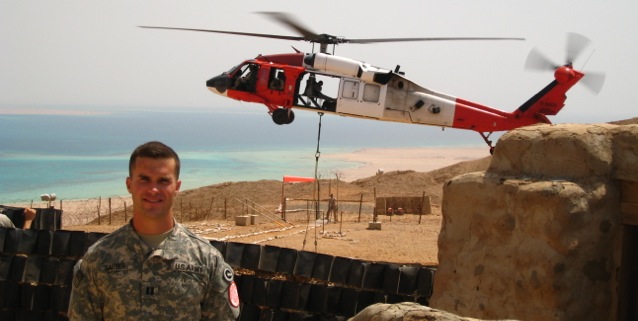
Dr. Elliott Garber being a bad ass veterinarian.
The time suck of the online presence for writers is a delicious topic to talk about -- maybe because we all fall victim to procrastination and what more self-rewarding, prophetic way to procrastinate as a writer than to talk about procrastination with another writer. "I had to cut back on blogging," continues Elliott. "I just couldn't do everything at once. I frequently saw on writing forums that a lot of people spend a lot of time talking about writing rather than actually writing."

Truer words were never spoken.

Luckily, Elliott remained unchained by the bonds of NOT WRITING and settled into a pattern. Writing in the evenings, Elliott honed technique and took time for research and learned a little about himself along the way. "One of the things I discovered about myself after the first few months of writing was that I couldn't write fiction very well while I had access to the internet. I was always wanting to look up something -- oftentimes related to the book, so it wasn't completely worthless -- but I would just keep bouncing back and forth between writing and getting dragged down the internet wormhole. Then I discovered this app called Freedom App which lets you turn off your access to the internet universally for a certain amount of time. It's funny to think about having to force yourself to do something that you're choosing to do, but I think for a lot of writers it's a struggle to produce content. But I think there's something about getting to the end that makes it worth suffering through the process."

Elliott then hit on a topic that had recently been discussed at my very own writer's group: as a writer, are you a pantser (meaning, you write by the seat of your pants, unplanned and free flowing) or a planner? Elliott discovered he could write his actual novel more efficiently if he had planned a few chapters in advance. "I would write in the style of telling myself what's going to happen without actually writing it in story form, so once I had that settled in my mind, I could switch to the actual story," he says. "It made a big difference in efficiency. There was no more agonizing over deciding what was going to happen next and then actually writing it."

In the end, with novel finished, Elliott explored the traditional publishing routes first. After getting an agent, he ended up rejecting offers from a few publishers, as he felt he'd ultimately have more control over his own intellectual property (and how it was formatted and sold) if he published independently. "From my own research, I knew the offer the publishers were giving me didn't represent much of an investment at all from the part of the publisher so really they would get it out there without a whole lot of input from me. So I turned those offers down. It has been a lot of work for me this year getting everything ready for independent publishing, so now it's a matter of time to see if it was a good investment doing it this way," he says. "But, I've learned a lot and had a good experience." Elliott writes about his process in more detail here.
Dr. Elliott Garber in India
Prior to The Chimera Sequence, Elliott self-published a short story, called No Dog Left Behind. Also available on Amazon, this was Elliott's first experience with independent publishing and it was a positive one. "I try to tell people there are lots of different ways to do this and it's better having a few people read your work than having it sit on your computer having no one read it at all. It was good training for a bigger project."

In the end, Elliott is extremely positive and open-minded about his own future, both as a veterinarian and as a writer. He acknowledges a sequel to his novel is a possibility, but he's not sure when that might happen. He's still waiting to see how well his first novel will do. "There are also a bunch of other things I like doing and am interested in, so I'm kind of doing other things while seeing how this novel goes. I also have other ideas about other totally unrelated books I'd like to write, too. It's just about making the commitment."

Well, hurry up, Dr. Garber. I want to see what all you can do.

Until next month, dear readers!


Monday, February 2, 2015

Refreshed, renewed, ready for action

Dearest readers,

I apologize. I have done one of the things I abhor in a blog. I have abandoned you. For the past six  months, this blog has been a wasteland. Maybe you were wondering if I was mad at you, or was being held for ransom somewhere, or even dead. Nope. Just being lazy. Lacking motivation. Entering that self-indulgent naval gazing that makes one ask banal questions like: what's the point?

But. I'm getting my shit together. I feel renewed.

The thing that has helped the most to get me motivated and back here typing like a mad woman (and finding loosely relevant yet fun images and/or links to accompany the madness) is alcohol.

No, I'm kidding. That was crass. I apologize again.

Seriously, the thing that really has helped get me out of a creative slump is answering the question: what do I want this blog to be? I mean, let's be honest. So far, it's been random. Like, all over the place, narcissistic ramblings with barely a shred of continuity. In other words, the ugliest patchwork quilt you've ever seen. I needed a subject and not just "Anna's favorite thoughts." Let's try to be a little more meaningful than that, shall we?

One of my favorite blogs is Maria Popova's Brain Pickings. This is a beautiful, inspiring, good-for-your-creative-soul blog that combines the wisdom of authors and artists of the past with the ingenuity and mindfulness of new writers and artists. She puts out a weekly newsletter every Sunday, which makes for some great Sunday morning reading and ruminating, if you're interested.
Me, totally ruminating on a Sunday morning.
Maria had a link last summer to a website with a blog called "4 Questions Everyone Should Themselves." The list was as follows (via Lindsey Saletta):

1. How much of your day do you spend consuming what other people have created? How often do you create?
2. How can you build a platform this year for you to stand on next year?
3. What are you doing that actually matters?
4. How can you inject more awe and wonder into your life?

I don't know about you, but this got me thinking some really heavy stuff. I thought these questions were so powerful, so soul-searching, that I wrote them down and now they live on a sticky note that sits in front of my face at my desk. I see it right now. There you are, deep sticky note. Hi.

In relation to this blog, the first question resonated. I needed to create more. But, in relation to the third question, its content should probably matter. Or at least I should try to make it matter.

So.

Here's the deal. The new, bright and shiny VetWrite blog is open for business. And here are the details:


There will be blogs, as best as I can muster, every first and third Monday of the month. Set your calendars, clear any appointments. Wear clean underwear. Pack your overnight kit. Be generally ready for anything.

My focus will be on veterinarians (practicing, not practicing, old, new, ugly, fat, freakishly thin, tattooed, boring, wearing glasses, smelling like lavender, pimply, oval-faced, etc.) breaking into the creative world, meaning as a writer, blogger, artist, speaker, entertainer, etc. As an industry, us veterinarians are so damn scientific. And I LOVE that. But, we have a creative side, too. And, as a profession, it's important to explore and celebrate that. So, put your party hats on cuz we're gonna celebrate.

I'd like to emulate in my own way how Maria writes her blogs; taking bits and pieces of creators and putting them in her blog in bite-sized pieces for the rest of us to chew. Over the next few months, I hope you'll join me as I talk to veterinary cartoonists, authors, bloggers, and entertainers. Doesn't this sound like fun?

Come on, let's set sail.


Wednesday, March 26, 2014

The ups and downs of writing (or: Are all writers bipolar or is it just me?)

Been working on some more articles for various animal magazines lately, so that's cool. What I've noticed, however, is the writing process for such an article (or more likely any freelance article) is for me an emotional roller coaster. As with many things, perhaps the best way to explain is through a visual aid. In this case, I've created a graphical representation titled: Anna's Emotional Writing Roller Coaster.

Anna's Emotional Writing Roller Coaster
Allow me to narrate this visual nugget of extreme wisdom.

On the X axis, you have Anna's 7 stages of non-fiction writing, which I will detail momentarily. On the Y axis, you have Anna's 7 writing moods. Blue represents positive and red represents negative. The more extreme the height or depth of the bar, the more extreme the mood.

Anna's 7 stages of non-fiction writing are as follows:

A: Idea/query   
This is, in my opinion, the happiest, most fun place for writing. You are not so much really writing at this phase, just daydreaming and coming up with ideas like, hey, wouldn't it be cool to write about how the decline in kraken sightings has led to the development of the Save the Kraken movement and how this has influenced the sale of eye patches? Once your half-baked idea becomes a little more solidified (like, OK, the correlation between Save the Kraken and eye patches is a little weak but there's still something worth writing about in the movement itself) you crank out a query or a pitch to an editor and off it goes. You're not only swimming deep in imaginative juices, but you are also able to check something off your to-do list, hence creative euphoria.

B: Go ahead/plan
OK, so now you've got the thumb's up from an editor; perhaps you're writing a piece on spec, maybe you've signed a contract. Either way, it's go time and you have to turn your theoretical story into something coherent on paper. Although feelings are still positive (Yay! An editor is interested in seeing what you can do!), you're focused now and you feel a little pressure because you have a deadline. The euphoria is gone but it's all good. You're workin' it, girl.

C: Finding sources
Now things start to fall apart. You know those three interviews you were sure you could get? Well, your one kraken expert is on sabbatical in Fiji, the president of the Save the Kraken movement won't return your emails or calls, and the grassroots member's interview was a disaster for a multitude of reasons, one of which was due to the fact that she was barely discernible through her drunken slur. Panic sets in because deadlines are looming and you have crap interviews, crap ideas, crap stories, and basically you are crap. You have stumbled into gloom.
D: Interviews
OK, so it appears all that panic over interviews was a little premature. Turns out the kraken expert is back in the US from Fiji earlier than expected and was more than happy to go over the intricacies of the dicey history of kraken sightings with you. Additionally, the vice president of the Save the Kraken movement got in contact with you and gave lots of quotable material. You suddenly find yourself more in love with your subject than you were previously because now other people are involved who are just as excited about it as you. Enter glee.

E: Fleshing out
You've got your interviews now, great. Most if not all of your research is done. Now you have a word limit to adhere to. All the fun parts are now over. The science of putting coherent paragraphs together that actually flow (and bonus points for being witty) is now your aim. But look: your favorite TV show is on. And you have to finish reading that library book since it is due in two days. And you have so many other ideas for other articles! The high from your awesome interviews is over. Gloom again sets in.

F: Deadline creep
Oh crap. Oh crap. Oh crap. Where did the muse go? Why is writing a single sentence torture? How did you suddenly forget to speak English? Why did you ever query this stupid idea in the first place? How is it suddenly 2 am? How much is too much coffee? Should you Google that? Oh look, a youtube video on how coffee is made. Congratulations, you've hit despair.
But what about the fifth draft???
G: Finish and submit
OK, you made it. It's finished. Actually, it's not half bad. You're sort of proud of it. There are a few good arguments in there. It will likely appeal to most readers interested in learning more about the Save the Kraken movement and you've certainly learned more about it yourself. Hit send and off it goes. You're relieved and hope that it will be well-received and who knows? Maybe it will lead to more opportunities. You're ending cautiously optimistic.

Anna's Emotional Writing Roller Coaster
Referring back to the chart, it's plain to see the highs and lows of this process. I can't be the only one who gets mentally wrung out--and all for only 1,200 word articles! I can't begin to imagine what special mental acrobatics are induced during the commitment of a novel. Maybe that's why all "classic" novelists were alcoholics...