Showing posts with label vet. Show all posts

Friday, June 7, 2013

Guilty or Am I the Only Soul Who Doesn't Like James Herriot???

I have a confession to make:  I do not enjoy stories by James Herriot.  As a veterinarian and writer and someone who enjoys the British countryside and is a decent, kind, caring person, I understand that this makes no sense.  He should be my idol. 

For those of you living under some sort of mega-rock for the past half century (or maybe you're just not into books about animals, I guess - I shouldn't be so harsh), James Herriot was a mid-20th century British veterinarian who wrote a series of semi-autobiographical books about being a vet in the British countryside.  His most popular book, All Creatures Great and Small, also became the name of the TV series on the BBC based on his stories. 

I feel that everyone loves James Herriot.  You are supposed to love James Herriot.  What's there not to love?  His stories are down to earth, humorous, and filled with little British-y quirks and mannerisms that make Americans squirm with delight. 

James Herriot - see? What's there not to like? And yet somehow...
And yet.... I first tried Herriot when I was in middle school, per recommendation from my mom.  I recall plucking an old, weathered paperback from the immense book shelf in our family room and settling down one evening to read all about vet adventures, adventures just like I dreamed for myself one day.... And after about thirty pages, that was it.  I was done.  I just.  Didn't.  Like.  It.

Haven't you ever started a book and you get this feeling like: eh, this doesn't feel like me.... and then sure enough, something just doesn't click and no matter what, you can't muster the gumption to finish the darn thing?  Rarely do I get that feeling, but when I do, man, it's impossible to kick and the book just languishes.  Life is way too short to waste time on books that don't "click", that's what I say. 

Given the fact that I was only a pre-teen when this occurred, I sensibly tried to give the book another shot when I was in college.  Home for summer vacation, again I picked up the same weathered paperback and tried (harder this time) to like it. 

Nope.

And that's it.  No three-strikes-you're-out thing for me.  Two tries - that should be enough.  Herriot and myself were just not meant to be.  It's like how some people just can't stand Hemingway or Shakespeare. 

This topic comes up occasionally.  It's like whenever people find out I'm a vet and love to read, they automatically ask about Herriot: "oh you must love James Herriot" or "you must've read all the James Herriot books."  And the truth, as you've learned, is: nope.  Then, when I openly admit I actually don't care for these books, the reaction is normally a shocked facial expression and an uncomfortable: "Oh, really?  Oh.... well...."  It's like I admitted I kill people and eat them or something.  (Which I don't, internet.  I don't.) 

And so, to keep random conversations with clients and other animal-loving people pleasant, when asked about Herriot, I sort of mumble something about how I've never really read any of his books, and then comment on the weather or scream: THERE'S A SPIDER OVER THERE which creates the perfect diversion.

The perfect diversion for awkward conversations
Now that I've come clean, I'm wondering if there's anyone else out there who isn't a fan of the lovable James Herriot.  When I Google "James Herriot bad reviews" or "people who don't like James Herriot", I get nothing.  Not even Google admits there are people out there like me.  But, if you're reading this and find yourself nodding in agreement to my riveting text, maybe we can form a support group or something... I'm thinking some sort of social event involving cookies.... 

And now I'm done hating on books.  Because the truth is, of course, I love books.  I live for books.  And I'd much rather talk about books I love than the ones I don't.  So this is the last time you'll hear me moan and groan about a book.  Well, except for Dickens.  I can't stand Dickens.  But that's for another blog...

Wednesday, May 29, 2013

Wormy Wednesday!


Wormy Wednesday!

It’s been a grotesquely long time since I’ve done a Wormy Wednesday, but I have good reason for one today, so here we go!  

A few weeks ago I had the great privilege to visit the United States’ National Parasite Collection (USNPC).  Bet you didn’t even know there was such a thing, did you?  Tucked quietly away at a USDA office in Beltsville, Maryland, an extremely unassuming building, nay, the BASEMENT of the building, holds the most amazing collection of parasites, both endo and ecto, in the world.  This is not just uber-veterinary-nerd-hyperbole.  It really does house the largest specimen collection in the world.  Of course it helps when most of your specimens are teeny tiny like fleas and sections of cattle liver fluke on a microscope slide.

Walking into this basement is a surreal experience.  At first, you just see compressed shelves – you know, the type that are on rollers to save space.  But when the shelves are opened up and you peer down one, you see jars upon jars of things in formalin.  And I love jars of things in formalin.  There’s just something fascinating and creepy all at the same time about something that’s been preserved for the past fifty years in a Mason jar filled with yellowing liquid.  Maybe this is the mad scientist in me speaking out.  I don’t know.  Perhaps I’m abnormally riveted by this sort of stuff.  

Yay! Random jars!
My abnormalities aside, the breadth of the collection combined with its history is practically awe-inspiring.  There were specimens in there from the last half of the 19th century!  The host animals ranged from the dog to Antarctic seals. 

However, in my opinion, for any parasite collection to be worth its salt, it must contain one of my most favorite parasites: the canine giant kidney worm.  My fascination with this parasite dates back to my vet school days in parasitology class, sophomore year.  Our professor had a modest collection of parasites for lab use, as most parasitologists do.  During labs we would examine ad nauseum the feeding and breeding apparati of various nematodes, trematodes, and cestodes (ooohh, look at that spicule!  Wow is that an excretory pore or what?) of prepared slides which were more than showing their age under the microscope.  Most interesting to me were the jarred specimens sitting at the front bench.

There was one specimen that immediately caught my eye – a kidney cut longitudinally.  Within this kidney was a worm.  Just a worm.  This thing had obliterated the entire inner structure of this organ and set up shop inside.  It was horrifying.  And so extremely fascinating.  Here are the deets:

The giant kidney worm is more politely called Dioctophyme renale, or D. renale for short.  It’s true host is the mink but occasionally an unlucky dog can become an unsuspecting host.  Eggs of D. renale are passed in the urine of the infected animal.  These eggs then go through a complicated life cycle involving various intermediate hosts such as fish and frogs.  With each pass through an intermediate host, the parasite slowly matures.  Then a mink (or dog) comes along and eats a fish or frog that is harboring these developing larvae.  Once ingested, the larvae of D. renale migrate eventually to the kidney where they grow to adults, breed, and pass eggs into the urine to start the life cycle over.

Here is D. renale in all its kidney-destroying glory.
One of the most interesting details of this parasite is that it only ever infects one kidney, and specifically, almost always the right kidney.  Although I’m not sure why the predilection for the right kidney, the parasite seems to know that if both kidneys were infected, the host animal would die.  And when you’re a parasite, you don’t really want your host to die, otherwise you're out on the street looking for a new place to rent.  So this adaptation of the one-kidney-only rule allows for the successful survival of this parasite.

Unlike common gastrointestinal parasites like tapeworms and roundworms which reside in the intestines and can cause weight loss and diarrhea and are diagnosed via fecal sample, D. renale is usually diagnosed when the host animal succumbs to kidney failure (since one kidney has been obliterated).  Treatment is removal of the infected kidney.

Although this all sounds really scary, fear not.  Even though the parasite has been reported across the United States, it is really, really rare to find it in dogs.  Are you a mink owner?  Well, then maybe be a little more worried about it.  I don’t know – I don’t treat minks.  Prevention is to not let your dog eat raw fish, frogs, and other icky wigglies out in the wild…. But try telling that to a Labrador.  Good luck.

A mink. Because I wasn't quite sure what one looked like. Appears similar to a ferret. Man, those are some beady little eyes!

So, anyway, to get back to my epic adventure in the halls of the USNPC, with bated breath I asked the question: “Do you or do you not have the giant kidney worm?”

And I was not disappointed.

There, on a table, was a dog kidney encased for eternity in a clear block of plaster.  Inside this kidney was D. renale, all curled up and tucked in, cozy as could be.  Amazing.  My trip was complete. Sadly, there were no postcards to purchase.


Sunday, May 5, 2013

More than one way to write a query or castrate a dog

This has been a roller coaster week - two half marathons in a row have kept me physically stressed and I've been busy at work refreshing my memory on cattle reproductive hormones (prostaglandins in particular, like good ol' prostaglandin E2, which means a review of the cyclooxygenase 2 pathway and all that good stuff).  However, I've tried to remain diligent with my writing and soon I'll have a few more queries to send out to magazines.

If you look up "how to write a query letter" you'll find an almost overwhelming amount of advice online which is simultaneously great and aggravating.  Yes, there is the standard set-up of a query letter: the "hook", the synopsis, and your biography, but just how you craft your hook can be done about a million ways.

I don't know about you, but although options are sometimes nice (like ice cream), for other things such as query writing and learning to drive a manual transmission, I want to be told ONE WAY to do it for starters.

ALL THE OPTIONS!!!

Some aspects of veterinary medicine are like this too.  Take castrations.  Junior year of vet school is when you begin to learn the art of surgery.  You start with the basics, which is the feline neuter.  Then you up the ante a little and progress to the canine neuter (interesting to note how different all the species are when it comes to testicles).  We would practice and refresh our anatomy on cadavers with the surgeons hovering around in the background trying to offer helpful tips.  I remember one particularly easy-going small animal surgeon (I know, I know: What? An easy-going small animal surgeon!? That's crazy talk!) offering tips when castrating a dog: you can do the "closed" technique or "open."  You can use two clamps or three.  You can use this suture and these knots, or this one over here.  You can close the skin with this suture pattern or that.  "Which one would you prefer?" he asked us in the anatomy lab, referring to which combination of methods to use during this surgery, almost like employing artistic license.

It was too much for me.  "How are we supposed to know?" I asked.  Asking which way I prefer when I've never actually done it was so weird and annoying to me, I was getting aggravated, not to mention confused.  What is the tunica albuginia again? Which is the Kelly hemostat?  Perhaps the formalin fumes were getting to me.  "Just show me ONE WAY to do it for now," I said.  "Once I get comfortable with that, then I can try other methods."

The day of the actual neuter on the actual (living) dog went fine.  Things were clamped, things were removed, and the dog woke up afterwards.  Now of course I forgot the way I chose to do it.  Also, I'll admit I don't neuter every dog the same way - different situations call for different methods.  I suppose it's sort of the same thing with a query letter. 

Now that I have lots of dog neuters and query letters under my belt, I'm not as stressed or annoyed when someone suggests something new.  I can nod my head and think: yes, I've thought about placing that ligature there.  Or: yes, I've wondered about including that piece of information here.  Having more than one option helps keep you flexible and even helps you be more creative (that creativity part only applies to queries - probably not a good idea to get too creative when castrating something....)

Now to explore my options in the ice cream department...

Saturday, October 20, 2012

Personality Test

The other day at work I took the Myers-Briggs test.  Well, they say it's not a "test".  They kept calling it an "instrument" since there are no right or wrong answers in the thing, therefore making it not a test.  Well.  Anyway, my results indicate I am what is classified as an ISTJ.  This stands for Introverted, Sensing, Thinking, and Judging.  Basically, it makes me sound like an asshole. 

The results weren't a surprise to me.  I've taken the test, sorry, instrument during freshmen year of vet school and I remember then I was also classified as an introvert, although I couldn't remember the other three categories.  What surprised me was my extremeness in a few of the categories.  I am EXTREMELY introverted and EXTREMELY judging.  This makes me sound like even more of an asshole.

This got me wondering.  I am engaged in two different professions: veterinary medicine and writing.  Sometimes these professions cross, like when I write articles about canine cognitive dysfunction, and sometimes they don't, like when I make another fruitless attempt at a novel.  How does an ISTJ personality fit with each profession?

An interesting blog from Banfield, the Pet Hospital (2010) states the traditional vet personality is the ISTJ/ESTJ - either introverted or extroverted individuals who would rather analyze data, make lists, stick to schedules.  However, more recent polls of new grads indicate more I/ESFJs - these are the more feel-y type people, being more influenced by feelings than logic and data.

Excuse me while I get my science on
I can understand ISTJs in the veterinary workforce.  We want to look at bloodwork, analyze glucose values of a diabetic cat, make decisions on antibiotic therapy based on cultures, wound contamination, and owner compliance.  We like our scheduled exams and the fact that we can make decisions on our own.

But, what about writing? I have always felt that no matter what kind of writing you do, except maybe grant proposals or really technical writing, like drafting a manual on the construction of carburetors, there is creativity involved.  And if there's something that doesn't fit well with an ISTJ, it seems to be creativity.

Reading about this further, though, it seems I'm thinking about this in the wrong way.  It's not that ISTJs can't be creative.  Rather, it's more about how they go about being creative.  In a blog about writer personalities, Andrea Wenger writes that ISTJs are efficient writers.  We ISTJ-ers prefer writing about demonstrable facts and usually have a set writing plan (guilty as charged).  Maybe this is why NaNoWriMo appeals to me: give me a plan, force my hand with a deadline, and (theoretically) I'm off and running.  Now to put theory into practice....

I'm curious about other writers out there - do you know your Myers-Briggs' personality type?  If so, do your writing habits match what your personality type indicates? 

Wednesday, October 3, 2012

Wormy Wednesday!

How embarrassing - my posterior bulb is showing!
Another installment of Wormy Wednesday for you folks out there just dying to learn a few fast facts about Oxyuris equi, more commonly known as the equine pinworm. 

Named because the female pinworm has a distinctive long, pin-like tail, this parasite resides primarily in the colon of horses.  The female adult worms the migrate to the rectum of the horse to lay their eggs.  This creates a stick white-yellow paste around the perianal region of the infected horse.  Understandably, this is itchy and pinworm-infected horses characteristically rub their tails on stall doors and fence posts, subsequently breaking tail hairs.

Rarely a pinworm-infected horse suffers from clinically significant health problems other than broken tail hair.

Pinworms can be diagnosed in the oh-so-technical test called the scotch-tape test.  This is exactly what it sounds like.  One takes a piece of scotch tape and sticks it to the horse's derriere.  The tape will pick up the pinworm eggs, which can then be viewed under a microscope.  Many common equine dewormers on the market treat pinworms. 

Wednesday, September 26, 2012

Wormy Wednesday!!!

What better way to introduce a new blog than a Wormy Wednesday?! Here's how it works: on a Wednesday such as today, I discuss a parasite of veterinary importance.  That's pretty much it.  But sometimes we all might learn something.  Or at least see a weird picture or two.

The barber pole worm - named due to its red and white stripes.
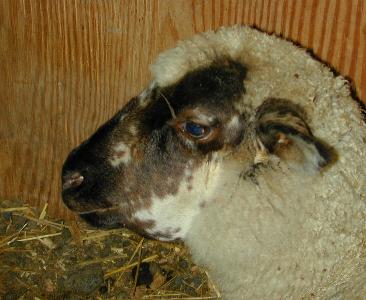
This week, let's start with something basic.  I introduce to you (drum roll please....) the barber pole worm (Haemonchus contortus).  This is the bane of sheep and goats worldwide.  A gastrointestinal parasite, this type of roundworm (or, as the cool kids call them, nematode) predominately resides in the abomasum (the fourth and "true" gastric stomach of the four-stomached ruminants) of sheep and goats, where it latches onto the mucosa and feeds on the delicate inner lining, ingesting blood and protein-rich tissue.  Severely affected animals lose such much blood that they become anemic and lose so much protein that extracellular fluid leaks from the blood vessels and into the surrounding tissue, causing edema.  Due to the position of the head while grazing, commonly this edema accumulates around the jaw, resulting in what is referred to as "bottle jaw".

Bottle jaw
Treatment involves administration of an appropriate dewormer.  Animals with severe anemia may require some extra TLC which sometimes includes extra nutrition and occasionally a blood transfusion.

So, that's it! Quick and dirty for the premier!