Showing posts with label cartoons. Show all posts

Tuesday, June 11, 2019

Zines as a Mean to Expression

Every late winter/early spring I get into doodling. It never fails. I don't know if it's the culmination of gloomy weather giving me cabin fever with a resultant desire to make maps or what.

Does this happen to you? This year, I got some decorated bee hives out of it, so there's definitely a perk to it all. But there's also a restlessness.

In the back of my head, I'm thinking: but what else? Is this a step to something bigger? Because tendrils of ideas have been sprouting, inspired over the past few years by various things.

Take this post by Linda Codega over at Luna Station Quarterly.

Take this article about the end of Subversive, the underground zine of downtown Frederick.

Take Laws Guide to Nature Drawing and Journaling and 50 Ways to Draw Your Beautiful Ordinary Life.

Take the monthly subscription called Zine-o-matic where you receive a collection of international zines, take Zine Fests, take the local donut shop stating they will only carry zines now as reading material . . . Take the concept of creative freedom as expressed by making something start to finish that can look and feel however you want, tell a story or not, make sense or not, be whatever media you want, and be so analog (or not) that you can freaking choose to hand stitch the binding.

Long story short: I want to make a zine. That's where this has been going all along and I recently put a name to it. 

I'm going full millennial here and searching YouTube on how to make a zine, looking for local classes, and then coming to the realization I just have to jump into the deep end, have fun, and figure some things out for myself.

Who cares right now if my T-Rex is a little mis-proportioned? Let's do it! 

Monday, May 2, 2016

Editing the Journal of Tomorrow

This month I have a unique interview lined up for you all. A few weeks ago I was able to connect with Dr. Marian C. Horzinek, editor-in-chief of Veterinary Sciences Tomorrow, an online, refereed journal that provides reviews and opinion papers (in contrast to experimental data) on the most current research in biological sciences. The journal's noble mission statement captures very well its intent and scope: "Veterinary Sciences Tomorrow is an electronic current awareness journal that aims to encourage and support the worldwide veterinary research community; it also wishes to give the community a sense of identity and appreciation of quality." Perusing the site, you will quickly find yourself immersed in a spectrum of topics as diverse as animal night vision to the genetics of autoimmune disease to a bit of paleontology. And that's just from the past few weeks. Check back again and you'll find updated information, links, and editorials, illustrating just how deep the well is in biological research. How fun to be the editor-in-chief, right? Let's see what Marian has to say about it.

Rewind to 2001. Marian was spending the last decade of his professional career in research administration, founding the Utrecht Graduate School of Animal Health and the Institute of Veterinary Research in the Netherlands. "I had interviewed many of the approximately 80 PhD students and found them focused on their research topic without looking left or right," Marian says. "My students knew everything about every amino acid in every glycoprotein of a corona virus, but nothing about a disease caused by it."

So he started to think.

"A web-based biomedical journal with a current awareness perspective seemed the right thing to do," he says. With moral and financial support from the Dean of the Veterinary Faculty at Utretch along with assistance from a professional web design office, Veterinary Sciences Tomorrow (also known by its web handle VetScite) was born.

At the start, the publication electronically published four issues a year and since 2002, Marian says, this has been continuous with biomedical news updates appearing at twice weekly intervals. The staff for this publication is small but mighty. Dr. Anjop Venker-van Haagen is the editor who works on the majority of the publication with current part-time help from a vet student. Marian notes there are no external funds. "We have never considered sponsoring," he says. "Because of the independence issue, there are always strings attached." The staff also has a cartoonist, Miroslav Pavlicek, whose drawings on the site are crafted from stories the site features and offer a visual component that is creatively exceptional.

"My favorite part of the job is to look at the material Anjop collects, to tweak some details, to suggest topics and discard others and to communicate with the authors, contributors, and students," Marian says. "Several have been or have become personal friends. Anjop is one of them." Anjop herself is a leading expert in ear, nose, and throat diseases of companion animals and author of the textbook on such conditions: Ear, Nose, Throat and Tracheobronchial Diseases in Dogs and Cats.

Perhaps it's important to take a minute to explain the unique niche that Veterinary Sciences Tomorrow fills. "The content of VetScite is not primarily laid out for the veterinarian practitioner," Marian explains. "Neither is VetScite a journal for publishing primary scientific work. This journal intends to fill another niche: it is aimed at the graduate student, the PhD supervisor, the postdoctoral fellow, and academic teacher, the veterinary scholar, the science journalist, the government researcher, the scientist." VetScite instead addresses the forward-looking academic teaching and pathophysiology/animal well-being/veterinary public health research scene, says Marian.

Given this broad brush (and to me, intimidating) approach, just how, then, do Marian and Anjop select content? Interestingly, Marian says he and Anjop look for what they think is funny. "We publish what may lead to new avenues of research, what is novel in the true sense of the word, what raises expectations," Marian says. "After all, the journal is about tomorrow."

"The journal is about tomorrow."

This blog has featured a few cartoonists in the past so it should be no surprise that I was taken by the cartoons published on VetScite, by the above-mentioned Dr. Miroslav Pavlicek. I had to find out more about the man behind these drawings and asked Marian to elaborate. "Miroslav is my cartoonist and a successful companion animal practitioner in a vet hospital in Hradec Kralove, Czech Republic," says Marian. "This is a rare combination and you can tell from his drawings that he knows the scene well. He has illustrated a number of books, advertising material for a vaccine company, and reliably provides new drawings for VetScite about once a month."
Cartoon appearing in VetScite, by Miroslav Pavlicek

You may notice that the cartoons on VetScite aren't there for the laughs, per say. Instead, they provide comment on a current article referenced on the site. "As most persons with a sense of humor, he is not funny, but rather considerate and thoughtful," Marian says of Miroslav. "His way of lateral thinking finds humorous aspects in any scientific discovery, which he portrays in his characteristic style."
Cartoon appearing in VetScite, by Miroslav Pavlicek

Moving forward, Veterinary Sciences Tomorrow continues to utilize multimedia technology and explore new and exciting topics as they relate to OneHealth. (The OneHealth concept is a large focus of Marian's work.) Since he and his staff are looking at the very edge of new biomedical research, I asked Marian about trend spotting. "Quite generally, any new technique or method that enters the biomedical scene initiates a trend," he says. "Cancer and immunology, ageing and neurology, genomics and behavior have been our focus, among others." Visit the tags in the News articles on the site to get the latest and greatest. To stay in-the-know, subscribe to their newsletter.

Until next month, dear readers!

Monday, February 16, 2015

An Artist Among Us

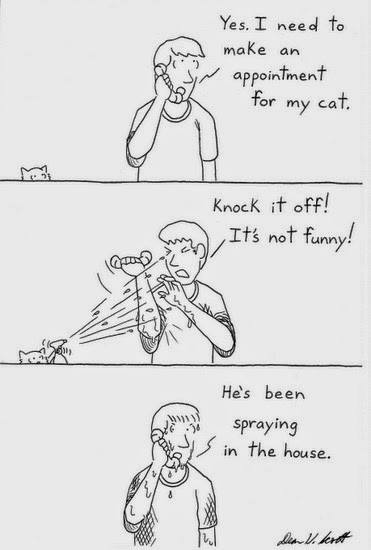
For the first installment of the newly reinvigorated and refocused VetWrite blog, I had the privilege to chat with a wonderfully creative veterinarian, Dr. Dean Scott. Dean is the creator of FunnyVet.com, and more to the point, a cartoonist. Some of you might be familiar with his art, as it makes its way across the web.
Originally from Orlando, Dean likes to say he survived vet school at UC-Davis and graduated in 1993. A general feeling of lack of support left him and his fellow students floundering in a sea of disinterested clinicians. "I found vet school harder than it needed to be, which is the best way to say it," Dean says. "It seemed like: hey, we got you to school and now good luck."

Fortunately, some vet schools now seem to have recognized the need for support for the very students they cultivate. This and the shift in student body population from primarily male to primarily female are some of the interesting ways that make today's vet schools in the US not the vet schools of yesteryear, which would make for a fascinating retrospective commentary in and of itself, but we digress.

The good thing about Dean's vet school experience--other than it allowing him to reach his childhood dream of being a vet--was that it honed his creative skills. He had fodder for doodles which became cartoons and two books. He had material and a method of therapy. Turns out, vet school is comedic gold.

Dean actually started drawing in 1988, prior to entry into vet school, when he was working at a small animal clinic. "It was a very small practice and I decided to put together some cartoons about things that happened in the practice and they really liked it."

Once in vet school, a small handful of drawings grew into collections. "Vet school was rife with material," Dean says. "During lectures I would doodle and make jokes in the margin of the syllabus. I just sort of wrote stuff down and it went from there." During Dean's junior year, he created a list called 1000 Vet School Stresses. Picking the best off this list, Dean had his first book, From the Back Row.

The late Dr. Sophia Yin was in Dean's class. "She had Cattle Dog Publishing and she was kind enough to throw me a bone, so to speak, and she published my first book." Another reminder that the vet world is a small, delicate world, friends. Let's keep each other close and take care of each other.

This brings us to an interesting tangent into the publishing world, a theme I'd like to explore deeper as these blogs continue. Dean cuts right to the chase when he describes his struggles of finding a publisher for his comedic vet material. "It's really hard. People understand text books but people do not seem to understand humor books in the veterinary profession." The responses he received from numerous publishers for this first book were lukewarm, at best. There simply was no interest.

"A lot of publishers, even if they do veterinary books, they don't do humor. Think about how few people that you can point to that do humor in the veterinary profession. What I see in our profession is that we need to lighten up."

So it's not just a question of how to get our work published. It's a statement of need. "I think at least in part, we deal with a lot of suffering," says Dean. "We shoulder a great deal of burden and we put that burden on ourselves a lot. I think we need to give ourselves a little bit of a break. I think there's a need out there for acknowledging how difficult things are without being morose about it."

Given that, Dean has been incredibly prolific. Hundreds of his cartoons are cataloged on his website; he's recently written a sequel to From the Back Row, Vet Med Spread; published a series called The Incomplete Dog Book on Smashwords; blogs; has a YouTube channel; creates his own vet-related graphics and designs for shirts and signs on Cafepress; and he still cartoons, publishing new ones on his website regularly.

Dean speaks on how to find time for your creative outlets. "Regardless of what profession you do, I think everyone has something in them that needs some kind of expression. I would never have thought cartooning of myself. I have no training. It just grew as an outlet. I think everyone has that. You do it for yourself first and you should never look at what you do as, oh, that's not good enough. It's not a matter of whether it's good enough. It's a matter of: it's what you do, it's how you express yourself.

"You have to make time [to be creative]. As vets, we are geared to do anything and everything animal all the time and if you have something else that gives you energy, you should go do that also. You do have to put a little internal pressure on yourself, but hopefully it's not the same kind of pressure that your clients put on you. But when you sit down and do it, it's relaxing, you find your brain playing with stuff. You have to give your brain play time."

Given the amount of cartoons Dean has produced over more than two decades, it's understandably difficult for him to have a favorite. "I like a lot of them, they're like children to me," he says. Fans, however, tend to have a standout favorite. "Everyone likes what I call the Boo Boo cartoon," says Dean. "It shows a veterinarian on the phone. You can't see his face because he has his hand on his forehead and he's saying: 'No Mrs. Smith, I don't think it would be helpful to put Boo Boo on the phone. Oh, hey Boo Boo.' Everyone loves that cartoon."


Stay tuned. Monday, March 2 is the next post.