Showing posts with label blogging. Show all posts

Friday, September 9, 2016

Writing to Dilute the Wrongs

There is an interesting and at times frustrating dichotomy found in the general opinion of the internet and social media: for some things, the internet is an awesome tool (e.g. ordering bowties for your cat). For other things, it is a terrible, monstrous entity (e.g. hateful platforms, blatantly incorrect and sometimes dangerous information, and trolls). Both the writing community and veterinary industry see both sides. It takes a certain type of talent to rein in the wild beasts of 21st century communication and one veterinarian and author, Dr. Kathryn Primm, has become an expert.
Kathryn Primm, DVM behind the scenes!
Kathryn is a small animal practitioner in Ooltewah, Tennessee, and owner of Applebrook Animal Hospital. In 2013, she published her first book called Tennessee Tails: Pets and Their People and is the "resident vet" for iheartdogs.com and iheartcats.com. Additionally, she regularly produces videos on a YouTube channel, is featured on local radio talk shows, and blogs. So. She seems busy. Luckily for us, I recently got a chance to connect with her. Here's what we talked about.

Surprising to me, Kathryn says her writing career started with her book. "I learned so much in promoting it," she says. "I liked going to the libraries/book signings and talking to new people. I found that people sometimes feel more comfortable with a stranger than with their own vet, so I saw it as an opportunity to encourage people to build relationships with their own vets. I started seeking media queries for chances to talk about the the book, but found that there were many topics people wanted to talk about. As I did interviews on TV and radio, I started to find it really fun."

Kathryn says her incentive for her book was her love of her patients and the role these animals play for their owners as well as for Kathryn as their vet. Finding time to write between appointments and after hours, Kathryn says a second book is on hold as she works on her other writing outlets and acknowledges that her growth as a writer during the process of the first book has helped her. "I am a much better writer now than I was when I started Tennessee Tails," she says. "It comes much more easily to me. I can be more efficient and it does not take me as long."

Given the spectrum of media outlets that Kathryn now has experience in, I asked her which is her favorite. "The most fun I have had lately is with the live stream videos," she says. "I did not think I would like it as much as I do. It is fast paced, fun, and they get a ton of views!"

"I want to give good, credible information to as many people as I can."

Always interested in educating people on various topics of vet med, Kathryn says currently her favorite topics to write about are animal behavior and nutrition. "I feel there is a lot of bad info out there on these topics and I want to give good, credible information to as many people as I can."

Given the various pitfalls of social media, Kathryn explains what she sees as the benefits of engaging with the public via these various platforms. "I see it as an opportunity to get people and pets back to the veterinarians," she says. In the fight against "Dr. Google," Kathryn aims to provide much needed veterinary information that is actually written by a veterinarian. Understandably, there are negatives to this, as well. Other than the time factor, Kathryn says she does receive a lot of online comments from readers who are seeking actual veterinary advice. "Unfortunately, I can't get into specifics of cases and always have to suggest that they see their own vet," she says. "I wonder if they find it frustrating."

"Social media has become a source of information for clients," she says. "You want to be sure that they are getting the best info possible. My goal is absolutely to provide the most accurate and useful information that I can. I do a lot of research and provide citations for those that want to know more. There is so much junk info out there. It is my mission to try to balance it with good info."

"If you love to write, you should."

Despite the ups and downs of working on social media (and the ups and downs with publishing), Kathryn remains upbeat and encouraging to those who might be thinking about dipping their toes in the writing water. "Just start," she says. "Write anything down that is important to you. Just think: what is the worst that can happen? You get to write your thoughts and feelings down in a cathartic journal? That is a GOOD thing! And the best that could happen is that other people love your writing as much as you do and you gain a platform to help them. You never know what life will bring your way. If you love to write, you should."


Monday, December 7, 2015

Online Chronicles of a Vet Student

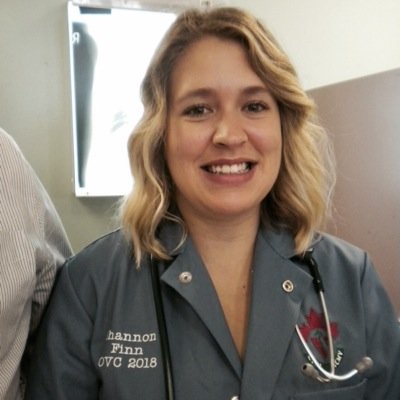
Recently on Twitter, I became a fan of a delightfully active, witty, and bright vet student, Shannon Finn. Attending Ontario Veterinary College, Shannon somehow finds time to craft insightful blog posts, interesting Tweets, and very clever Vines. All told, I'm a bit jealous of her craftiness at the whole online presence; this young woman is GOOD. She gets it. So I contacted her last month to ask her some questions. And here's what she taught me. Maybe you can learn something, too.

Currently in her sophomore year at OVC, Shannon comes from a small town in Ontario, Canada, about an hour and a half outside of Toronto. She says so far she is really enjoying vet school and 2nd year has her excited about theriogenology and how should I say it gently... a bit less enthusiastic about radiology. In Shannon's own words, "Reading abnormal radiographs is a lot tougher than it seems!" Preach it, sister.
Shannon Finn
Shannon primarily uses Twitter and Vine as her main online modalities, and she blogs as well. Her recent blog, "The value of your veterinary dollar: a vet student perspective" has gained a lot of attention and is well deserved. Shannon uses data combined with real life examples to paint a stark picture of the economics of the current veterinary profession. "I like Twitter because it's so quick and simple to connect with people," says Shannon. "You can add pictures and links and have conversations and ask questions and even Tweet right at someone you admire. It's just SO easy to interact, which is what I love. Vine is also a lot of fun - you only have six seconds for a video so you have to be creative. Six seconds involves a lot more planning than you'd think! I think it's a quick way to show something neat, like blood smearing or suturing or a time lapse of all your notes. I feel like having these quick social media snippets (six second videos and 140 character Tweets) is a good complement to the longer story telling that I get to do on my blog."

Shannon says she uses her social media platforms for education and entertainment. "I think the more the public knows about what we learn and what vet school is like, the more trust you can build in that relationship," she says. "People are always interested in animals and how you become an animal doctor, so why not make it accessible to them? I remember being an eager little pre-vet in undergrad and I would have killed for a good Twitter account or vet school blog."

"People are interested in animals and how you become an animal doctor, so why not make it accessible to them?"

Now that Shannon is providing that service for current pre-vets and others who would like to know exactly what goes on in the anatomy lab or the hospital, she also offers advice on what not to share. "I think that you always have to be careful and aware of what you put on the internet, especially with a medical setting where you have client-patient-relationships," she says. "Confidentiality and over-sharing can be a pitfall, but once you become familiar with what's acceptable and what's not, it becomes common sense to realize what's OK to post and what not to. Another thing is to use social media as a venting space. It's just so easy to throw negativity out there when you have a rough day. I really try and stay away from that and make it a more positive space. I mean, snark is so instantly gratifying but I think it just looks bad in hind sight. The internet is filled with negativity, so why add to it?"

"The internet is filled with negativity, so why add to it?"

Shannon has a history of being an avid reader (she admits to blowing away the competition in a reading contest at her childhood library) and cites other veterinarians as authors that inspire her. Dr. Sarah Boston makes Shannon's list (remember we talked to Sarah a while back?) as does Dr. Elizabeth Stone, the co-founder of the Society of Veterinary Medicine and Literature, and another VetWrite interviewee alumni. "I basically admire anyone in our field who takes the time to write and share their thoughts and passions for our wonderful career with others," Shannon says. "It's sometimes nice to have a break from being so science-oriented and appreciate the more poetic aspects of what we do."

For some folks, the concept of building an online presence, or a platform if you will, can seem overwhelming. For example, consider your choices: blogging, Twitter, Instagram, Vine, Facebook, Google+, YouTube, Pinterest, Snapchat, LinkedIn... I'm getting sweaty just thinking of all the different modalities. Shannon offers some sage advice for those who are interested in getting their foot in the internet door. "I think for most people, you start with what you're familiar with and what you enjoy," she says. "Think about if you like information sharing, picture sharing, or story telling. I don't think you can go wrong with picking a modality as long as you take the time to learn about how to use it, what appropriate use is in your job, and who your audience is. I would say the ultimate piece of advice is that you get out of it what you put into it. If you spend time formulating good Tweets, coming up with good blog ideas, and interacting with others, you will find it more rewarding for sure. It's definitely not a passive process."

Looking into the future, Shannon is interested in OneHealth. "I really like the concept of solving important problems at more of a population level," she says. She remains open to the vast opportunities that are available for today's veterinarian. But for now, there's one thing Shannon sees as a definite no-go: "Definitely not to be a radiologist!"
See you next month!

Monday, August 10, 2015

Believable Blogging

A few weeks ago I had the chance to chat with Dr. Jessica Vogelsang, veterinarian and social media maven, commonly known as Dr. V. Some of you may be familiar with Jessica's popular blog, Pawcurious, or her numerous other writing activities, such as blogger over at petMD and frequent contributor to DVM360, not to mention other national publications and media appearances. Most recently, this summer Jessica's first book came out--All Dogs Go to Kevin--a veterinary memoir. Jessica and I talked about writing for the masses via social media and she offered plenty of sage advice. Let me share that with you.
Jessica graduated from UC-Davis School of Veterinary Medicine in 2002. Having always enjoyed writing, Jessica turned her hobby into something more substantial as blogging gained a foothold. "I've been writing forever," she says. "I had never envisioned it actually being an effective way to educate large groups of people, it was just sort of me writing to friends who were interested in hearing what life was like as a vet." As technology became more on-line friendly, and with some help and encouragement from her husband who has IT experience, Jessica discovered blogging was a perfect fit as a writing outlet.

"The idea of using social media to educate people on a larger scale really became more front and center," Jessica says. "One of the things that is challenging for professional people on social media is that you really need to engage people on a personal level and that's really hard for a lot of people who want to write things very informational and very impersonal. That's not really what people are looking for. So, blogging has been an exercise in trying to strike that balance: to give accurate, professional information while still being relatable. That's what I've been trying to do."

A reader of Pawcurious will quickly notice Jessica's writing voice. Although veterinary in nature, Jessica weaves in her own life experiences between the science. Her's is not the "Ten Tips to Treat Fleas" site. Instead, Jessica shares her life as a vet, a mother, and an individual with her audience. "Everything I wanted to say medically I did in the first year," she says of her blog, which started in 2009. "Vaccines, nutrition, everything. Now I like writing about what I do in the voice that I have. I write about things going on in my own life and own work. If I can't tie it back to something that's going on in my life or in the news, then it's not as interesting to me. There are only so many times you can write about core vaccines." TRUTH.

"There are only so many times you can write about core vaccines." 

Blogging about how you vacuum your carpets is one thing, but blogging about vet med for general public education is an entirely different monster. Jessica knows this first hand and discusses what she views as the pros and cons of social media for those in the vet biz. "The pro of social media is that everyone has a voice," she says. "The con is the same thing. It is good and bad. Social media is a great way to talk to people that you would have never come across, but on the same token, you have people who are really good at establishing a personal relationship but they don't necessarily use that to share appropriate information. Someone can have a million fans and spout stuff that makes zero sense. It is frustrating when you see somebody selling snake oil and undoing all the good work you've been doing for so many years just because he or she as a good graphic designer."

So, the book. Jessica describes her memoir process as backwards because she was approached by a publisher who asked if she would write a book. Of course she said yes (duh), so then she acquired an agent and only then did they decide what the book was going to be about. Crazy, right? Normally, the book process goes: write, submit, rejection, rejection, rejection, (x 104392), then agent and then publisher. (But, my dear readers and writers: NEVER GIVE UP.)

Jessica admits her version of the writing game is unique. "Traditional publishing is so much work," she acknowledges. "If I had to do it the traditional way, I don't think I would have the tenacity to keep going. These novelists are incredible, given the rate of rejection they receive. I was fortunate that I had a lot of guidance and I knew that at the end of the day this was going to be a published book."

OK, so now that we are all incredibly jealous of Jessica's backwards path to publication, what is her book about? "The book is a memoir about three dogs that I had at three interesting points in my life," she says. "My Lhasa I had as a child, the Golden Retriever I had as a graduate student, and the crazy Lab I had as I got older. It features personal stories and stories from the vet clinic. I wanted to share the wonder of what these little guys bring to our lives and how they have this purpose that we may not even recognize until they are gone."

"I wanted to share the wonder of what these little guys bring to our lives."

The memoir writing process has always been a source of fascination to me. How can a writer dig deep enough to make the language compelling? Is there a chance of digging too deeply? Is it a fine line? "It was an emotional process because when you are writing a memoir, you are really trying to revisit those moments and find the words to describe the emotions you are going through," says Jessica. "I write about the deaths of my own pets in detail and it was hard. I spent some times at one in the morning typing and crying. It does take a lot out of you. But you have to be willing to go there if you want your writing to affect people. If you write detached then the reader will be detached as well."

"If you write detached then the reader will be detached."

Naturally, the conversation turns to time. Where is it? Can you buy more of it? Is there a vending machine that dispenses half hour chunks for a few quarters or part of your soul? For those particularly in the veterinary field, finding time to write or do another hobby or even brush your teeth on a regular basis is sometimes a challenge. These "other" things are part of what is called self-care and there is a lack of it in the vet med world. This is a problem.

"I think we are conditioned to feel guilty either by colleagues or by clients to want to take time for ourselves," says Jessica. "That's crazy to me. We get it more than any other profession out there. I don't understand why that is. Why do people feel perfectly free to demand ownership over our lives, over this professional decision we made, and think they have the right to tell us that we should sacrifice everything? This has to be something that is discussed by the profession as a whole. Self-care has to be obligatory in this type of profession if you want to maintain your sanity."

This concept of self-care and its deprivation in the vet med realm is something that social media has helped moved to the forefront. "When we had several high profile suicides in the last couple of years and everybody was shocked and started talking, it was like: oh, me too," says Jessica. "It was like every single person was going through the same thing. [Sharing] has really opened the dialogue. That's just as important as the self-care itself: having that ability to speak with other colleagues who validate those feelings."

Jessica and I ended our conversation with some words of wisdom to impart on those intrepid would-be bloggers. "First thing, anonymity is a lie," she says. "Do not think you can post anonymously online. You have to be careful. The other thing is be aware. Of course you want to educate and enlighten people but people will take what you say to justify what they already believe, for good or bad. You can control what you write but you can't control what people do with it once it's out there."

"Anonymity is a lie."

At the end of it all, whether you're looking to create your own blog, or post pictures of your amazing Pug or Persian or Palomino on Instagram, or write the most amazing, fascinating, refreshing articles on core vaccines, just remember to do your best. And of course you will. "I'm going to write what I care about and create quality content and hopefully that will be enough," Jessica says. "I just want to be true to the things I think are important. And I think that's really the best anyone can do." Amen, sister.