Showing posts sorted by relevance for query elizabeth stone. Sort by date Show all posts

Monday, April 6, 2015

A collection of kindred spirits: The Society for Veterinary Medicine and Literature

It's funny, isn't it, when something you didn't even know you were looking for suddenly pops up out of nowhere? That's what happened recently when I discovered The Society for Veterinary Medicine and Literature. What? I thought. You mean to tell me there's a group of vets out there who wants to talk about vet med as it's found in literature??? I assure you, it's true--the DVM book lover's Shangri-La. I spoke to one of the two founders of the group, Dr. Elizabeth Stone, to find out more.

The concept of the Society started in 2001 when Elizabeth and her co-founder, poet Hilde Weisert, put together an elective course for students at NC State University's College of Veterinary Medicine covering vet med and literature. After Elizabeth became Dean at Ontario Veterinary College, she brought the elective with her. "When I had the classes both at NC State and Ontario, the students who would sign up, for many of them, it was like an oasis," she says. "It's like they'd just been all science to get into vet school and once they get in, of course, it's all still science. It's like they have it hidden away in a drawer that they like these other things and they found some other people in the college who were interested in reading. It gives legitimacy to their interest. It's not serious science stuff for once."

After accumulating extensive positive feedback from students who had taken the course, Elizabeth and Hilde went on to organize the first ever international Veterinary Medicine and Literature Symposium in 2010 at the Ontario Veterinary College and in 2012, as editors, published their first collection of short stories and poems sharing the theme of animals and vet med, titled Animal Companions, Animal Doctors, Animal People.

Just two years later, Elizabeth collaborated with fellow veterinary professor Cate Dewey to edit another collection of vet med stories, this time featuring zoonotic diseases and titled Sick! Curious Tales of Pests and Parasites We Share with Animals.

Overall, the Society, "promotes the reading and discussion of literary works to explore important issues in veterinary medicine--and for the intrinsic pleasure and value of reading and discussing good literature, a way of renewing one's joy in being a veterinarian and a human being." Although the past few years have been relatively quiescent for the society, Elizabeth and Hilde plan on ramping things up again.

"We've cycled in and out depending on where we are in our lives," says Elizabeth. "But we really do believe in it. We need more than just Hilde and me working on it. It needs to be a true discussion, bringing in different points of view."

To this end, currently the Society meets virtually in an almost monthly fashion to discuss future plans for the group as well as what folks are reading and the relevance to vet med. Membership is free and if you're interested, contact information is available here.

Elizabeth's background in research is evident in one of her goals for the Society, which is to attempt to inventory what's available in terms of written work produced by veterinarians. "Blogs, Twitter accounts, what books are out there by and about other veterinarians, just so people know what's available," she says. "And having links to those things so people can get to them."

Analyzing what literature has to say about veterinarians can also play a vital role in a concept that is currently being discussed and emphasized in North American veterinary schools: diversity. "One of the things that has been impressed upon me while we work with students is that there is a way for people to learn about other societies and that is reading about them. I think using readings from different people's perspectives is another way to teach diversity," she says.

What about those who--gasp--just don't like to read? "There are some people that, because of their backgrounds--maybe in high school they had to dissect a poem--they really really don't like literature," Elizabeth says. "I don't think we're going to change their minds. But those people who are sitting on the fence or do really like it, I think there's a lot there we can work with."

When talking about literature in vet med, the subject of narrative medicine tends to come up. Far better known in human medicine but perhaps still not considered mainstream, narrative medicine is the medical approach that recognizes the importance of the patient's narrative to the clinical perspective. This encompasses listening to the patient's background story and therefore appreciating where the patient is coming from. Sound compassionate? That's the point. And I think to a great extent, veterinarians use this method as well (e.g. our patients can't talk to us so we get the story from the owner), but perhaps we just don't have a formal label for it. Narrative medicine also includes reading and writing on the physician's side, as means to foster creativity and self-reflection. Starting in 2009, Columbia University is now offering a master's program in narrative medicine. Additionally, there is actually a literary journal published called Intima that is specifically a journal for narrative medicine. What a wonderful creative tool for physicians!

**SOMEONE PLEASE START ONE FOR VET MED!!!**

Naturally, a conversation with Elizabeth eventually turns to the market for books about vet med or works that feature veterinarians. Given her background of scrounging for vet med-related pieces for her elective courses and for the Society, she has interesting insight into what's out there. "A lot of the work that is written by veterinarians is humorous, the 'guess what I have in the refrigerator' kind of thing. That may only go so far," she says. "Also a lot of it is making fun of clients which of course is the favorite pastime of veterinarians [it's true, sorry] but people who are clients don't necessarily want to read about that [also true]."


Somewhat ironically, although we work with animals and practically live for animals, what people seem to want to read about are humans, no matter the context. Elizabeth points to the king of vet med in literature, James Herriot, as an example of this. "What he's really writing about is the people," she says. "The descriptions of him finishing vet school and going into practice for the first time--we've used those chapters before in our classes and I think they really speak to people."

However, there is something about those darned saccharine sweet doggie tales that keep popping up on best-seller lists. "There do seem to be books about dogs that are best sellers," Elizabeth agrees. "What is it about that, from the veterinary side of it?"

I suppose if put head to head with a James Patterson thriller, I'd pick the sugary dog tale, too. On mere principle, of course.


Monday, February 5, 2018

Poetry for Pets

Poetry is . . . what is poetry? High school English class taught us it doesn't have to rhyme and the work continually featured in literary and poetry magazines shows us poetry can almost be damn well anything as long as someone believes in it. OK, maybe that's getting a bit too Disney but in all seriousness, poetry is still a bit of a mystery to me yet I find myself continually drawn to it, trying to understand, trying to learn, and in the process of it all, collecting more and more pieces that I like. It's like broadening one's palate. On that note, I was delighted to snag Dr. Marjorie McMillan to ask her about a recent book of poetry she's published. Marge, owner of the Windover Veterinary Center in Walpole, MA, and board-certified veterinary radiologist, has recently published Cold Wet Noses, Whiskers and Tweets, a book of poems for and about animals. Here's what she had to say. 

"I have been seriously writing poetry for about five years," said Marge. "I belong to a poetry writing group and we meet to encourage each other and critique each others' work. Much of my poetry is about nature and animals and I finally had enough poems to publish a collection. I also wanted to be able to convey to my clients and the general public some of the emotions that go along with being a veterinarian."

"I wanted to convey to my clients and the general public some of the emotions that go along with being a veterinarian." 

Most people have an inclination toward a particular breed of pet for a plethora of reasons. I wondered if a certain favoritism found its way into Marge's poems, but she emphasized the individual. "It's not so much a particular species or breed," she said, "but what inspires me as a poet is a certain animal or situation or emotion that I want to express in powerful language." Evoking emotions in those who read her poems is the aim. 


Tackling the subject of rhyme in poetry, Marge said she's in it for the challenge. "I like to write in rhyme and meter; it's harder than open style, so I like the challenge, but not all topics lend themselves to rhyme and meter. It's hard to get it really right like the great poets. Most people who are not serious readers of poetry seem to prefer poems that rhyme."

Given the intricate, intimate, and sensitive nature of most poems, it seemed to me there must be a certain level of empathy required to write poetry. Herein lies my connection between the creative arts and veterinary medicine because to truly connect with patients and clients, a veterinarian (this also applies to physicians and others in the wide spectrum of medical sciences) should also be highly empathetic. I asked Marge if she thought attributes of poetry writing crossed over into the successful practice of veterinary medicine and vise versa.

"Poetry allows me to connect on a deeper level with clients and it also gives them insight into the depth of my feelings. It creates a stronger veterinarian-client bond." 
"There has been much published lately about the mental health of veterinarians and the suicide rate," she said. "Poetry allows me to process the very difficult emotions around ending animals' lives, the difficulty of dealing with angry and sometimes impossible clients, and the joyful experiences. It allows me to connect on a deeper level with clients, especially around the loss of their pets, and it also gives them insight into the depth of my feelings. It creates a stronger veterinarian-client bond." 

This connection between the sciences and arts is occasionally nurtured at graduate school; see the elective course at North Carolina State University's College of Veterinary Medicine featuring writing, reading, and discussing poetry, short stories, and novel excerpts in order to "help engender empathy for clients, encourage moral reflection, and sustain the joy of being a veterinarian." See VetWrite's interview with Dr. Elizabeth Stone for more on that. Another example is the Trent Center for Bioethics, Humanities, and History of Medicine at Duke University. 

What's more is Marge's fulfillment from having others read her work. "A poem isn't a poem until it is read by someone else," she said. "Writing poetry has allowed me to connect in a deeper and more spiritual way with animals and nature."

What's extra special about Marge's clinic, Windover Veterinary Center, is that the creativity does not stop with her. Cathy Symons, a certified veterinary technician and certified canine rehabilitation professional is an associated specialist with the clinic and has written a book titled Blind Devotion: Enhancing the Lives of Blind and Visually Impaired Dogs. Joan Powers, Windover's hospital manager, was the photographer for Cathy's book. "I have a wonderful staff of creative women," said Marge. "The writing is a way of helping clients and animals in a right brain way. It allows us to step out of our usual medical roles and left brains and relate to clients in a different way. I also think it allows us to listen differently and hear beyond the factual medical history." 

Marge has a second collection of poetry in the works as well as a book half finished about her lawsuit for gender discrimination. She also confirms that her favorite poet is indeed the wonderful Mary Oliver. 

Until next time, dear readers: happy reading, happy writing, happy vetting.

Monday, December 7, 2015

Online Chronicles of a Vet Student

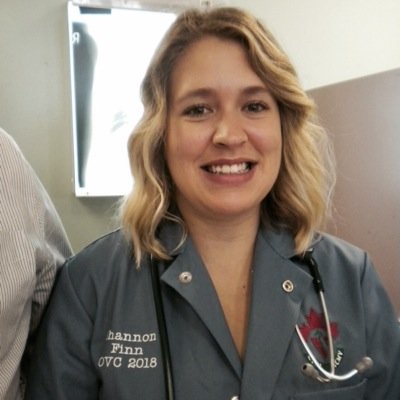
Recently on Twitter, I became a fan of a delightfully active, witty, and bright vet student, Shannon Finn. Attending Ontario Veterinary College, Shannon somehow finds time to craft insightful blog posts, interesting Tweets, and very clever Vines. All told, I'm a bit jealous of her craftiness at the whole online presence; this young woman is GOOD. She gets it. So I contacted her last month to ask her some questions. And here's what she taught me. Maybe you can learn something, too.

Currently in her sophomore year at OVC, Shannon comes from a small town in Ontario, Canada, about an hour and a half outside of Toronto. She says so far she is really enjoying vet school and 2nd year has her excited about theriogenology and how should I say it gently... a bit less enthusiastic about radiology. In Shannon's own words, "Reading abnormal radiographs is a lot tougher than it seems!" Preach it, sister.
Shannon Finn
Shannon primarily uses Twitter and Vine as her main online modalities, and she blogs as well. Her recent blog, "The value of your veterinary dollar: a vet student perspective" has gained a lot of attention and is well deserved. Shannon uses data combined with real life examples to paint a stark picture of the economics of the current veterinary profession. "I like Twitter because it's so quick and simple to connect with people," says Shannon. "You can add pictures and links and have conversations and ask questions and even Tweet right at someone you admire. It's just SO easy to interact, which is what I love. Vine is also a lot of fun - you only have six seconds for a video so you have to be creative. Six seconds involves a lot more planning than you'd think! I think it's a quick way to show something neat, like blood smearing or suturing or a time lapse of all your notes. I feel like having these quick social media snippets (six second videos and 140 character Tweets) is a good complement to the longer story telling that I get to do on my blog."

Shannon says she uses her social media platforms for education and entertainment. "I think the more the public knows about what we learn and what vet school is like, the more trust you can build in that relationship," she says. "People are always interested in animals and how you become an animal doctor, so why not make it accessible to them? I remember being an eager little pre-vet in undergrad and I would have killed for a good Twitter account or vet school blog."

"People are interested in animals and how you become an animal doctor, so why not make it accessible to them?"

Now that Shannon is providing that service for current pre-vets and others who would like to know exactly what goes on in the anatomy lab or the hospital, she also offers advice on what not to share. "I think that you always have to be careful and aware of what you put on the internet, especially with a medical setting where you have client-patient-relationships," she says. "Confidentiality and over-sharing can be a pitfall, but once you become familiar with what's acceptable and what's not, it becomes common sense to realize what's OK to post and what not to. Another thing is to use social media as a venting space. It's just so easy to throw negativity out there when you have a rough day. I really try and stay away from that and make it a more positive space. I mean, snark is so instantly gratifying but I think it just looks bad in hind sight. The internet is filled with negativity, so why add to it?"

"The internet is filled with negativity, so why add to it?"

Shannon has a history of being an avid reader (she admits to blowing away the competition in a reading contest at her childhood library) and cites other veterinarians as authors that inspire her. Dr. Sarah Boston makes Shannon's list (remember we talked to Sarah a while back?) as does Dr. Elizabeth Stone, the co-founder of the Society of Veterinary Medicine and Literature, and another VetWrite interviewee alumni. "I basically admire anyone in our field who takes the time to write and share their thoughts and passions for our wonderful career with others," Shannon says. "It's sometimes nice to have a break from being so science-oriented and appreciate the more poetic aspects of what we do."

For some folks, the concept of building an online presence, or a platform if you will, can seem overwhelming. For example, consider your choices: blogging, Twitter, Instagram, Vine, Facebook, Google+, YouTube, Pinterest, Snapchat, LinkedIn... I'm getting sweaty just thinking of all the different modalities. Shannon offers some sage advice for those who are interested in getting their foot in the internet door. "I think for most people, you start with what you're familiar with and what you enjoy," she says. "Think about if you like information sharing, picture sharing, or story telling. I don't think you can go wrong with picking a modality as long as you take the time to learn about how to use it, what appropriate use is in your job, and who your audience is. I would say the ultimate piece of advice is that you get out of it what you put into it. If you spend time formulating good Tweets, coming up with good blog ideas, and interacting with others, you will find it more rewarding for sure. It's definitely not a passive process."

Looking into the future, Shannon is interested in OneHealth. "I really like the concept of solving important problems at more of a population level," she says. She remains open to the vast opportunities that are available for today's veterinarian. But for now, there's one thing Shannon sees as a definite no-go: "Definitely not to be a radiologist!"
See you next month!